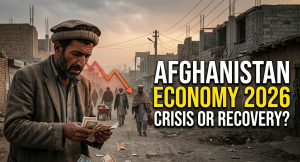
Afghanistan’s economy has undergone profound transformation and disruption over the past few decades, shaped by prolonged conflict, political instability, and external dependency. The situation changed dramatically after the withdrawal of U.S. and NATO forces in August 2021 and the return of the Taliban to power. Since then, the country has faced economic isolation, reduced foreign aid, and structural challenges that continue to define its economic trajectory in 2026.
This report examines Afghanistan’s current economic condition, including macroeconomic trends, key sectors, humanitarian challenges, and future prospects.
Afghanistan’s economy contracted sharply following the political transition in 2021. According to estimates from the World Bank and the International Monetary Fund, GDP declined by over 20% between 2021 and 2022, marking one of the worst economic collapses in recent history.
By 2024–2025, the economy showed signs of stabilization, but growth remains fragile. Key macroeconomic features include:
Low GDP Growth: Estimated growth rates remain modest, hovering around 2–3% annually.
Deflationary Pressures: Reduced demand and limited liquidity have led to periods of deflation.
Currency Stability: The Afghan afghani has shown relative stability due to strict currency controls and limited imports.
Reduced Public Spending: Government expenditure has dropped significantly due to reduced revenue and lack of international recognition.
Before 2021, Afghanistan relied heavily on international assistance, which accounted for nearly 40% of GDP and funded around 75% of public expenditures. Following the Taliban takeover:
Major donors, including the United States Agency for International Development, suspended direct funding.
Afghan central bank assets worth billions were frozen abroad.
Afghanistan lost access to global financial systems, including support from the International Monetary Fund.
This financial isolation has severely limited the government’s ability to manage fiscal policy, stabilize the banking system, and invest in development.
The banking sector has faced significant stress:
Withdrawal limits were imposed to prevent bank runs.
Public confidence in banks declined sharply.
International transactions remain restricted.
Despite these challenges, some stability has returned due to strict regulations and reduced economic activity. However, access to credit remains extremely limited, hindering private sector growth.

Agriculture remains the backbone of Afghanistan’s economy, employing over 60% of the population. Major products include:
Wheat
Fruits and nuts (especially almonds and pomegranates)
Livestock
However, the sector faces challenges such as drought, lack of modern technology, and limited access to markets. Climate change has further worsened agricultural productivity.
Additionally, Afghanistan remains one of the world’s largest producers of opium. Despite the Taliban’s ban on poppy cultivation, illicit production continues to influence rural incomes.
Afghanistan is rich in natural resources, including:
Copper
Lithium
Iron ore
Rare earth elements
There has been growing interest from foreign investors, particularly companies from China, in developing mining projects. However, large-scale extraction is limited due to:
Security concerns
Lack of infrastructure
Legal uncertainties
If properly managed, mining could become a major source of revenue in the future.
Afghanistan’s trade sector has undergone adjustments:
Imports have decreased due to reduced purchasing power.
Exports (especially agricultural goods and coal) have slightly increased.
Key trading partners include Pakistan, Iran, and India.
Border trade and informal markets play a significant role in sustaining economic activity.
A large portion of Afghanistan’s economy operates informally. This includes:
Small businesses
Street vendors
Cross-border trade
The informal sector has expanded due to the collapse of formal institutions, providing livelihoods but limiting tax revenue for the government.
Afghanistan faces one of the world’s worst humanitarian crises. According to the United Nations:
Over 90% of the population lives below the poverty line.
Millions face acute food insecurity.
Malnutrition rates among children are critically high.
Humanitarian aid continues to flow through international organizations, but it is not sufficient to fully address the scale of the crisis.
Unemployment and underemployment are widespread:
Many former government employees lost their jobs.
Women’s participation in the workforce has declined significantly due to restrictions imposed by the Taliban.
Youth unemployment remains a major concern.
The lack of job opportunities has led to increased migration, both internally and externally.
Initially, Afghanistan experienced high inflation due to supply disruptions. However, declining demand and economic contraction later led to deflation.
Despite some price stability:
Household incomes have fallen sharply.
Purchasing power remains low.
Basic goods are still unaffordable for many families.
International organizations continue to play a critical role in Afghanistan’s economy:
The United Nations provides humanitarian assistance.
The World Bank funds basic services through trust funds.
NGOs deliver essential healthcare, education, and food aid.
However, the absence of formal recognition of the Taliban government complicates long-term development efforts.
Infrastructure development has slowed significantly:
Many projects funded by international donors have been halted.
Electricity supply remains limited and dependent on imports.
Transportation networks are underdeveloped.
Some regional initiatives, such as trade corridors and energy projects, offer potential for future growth.
Afghanistan’s digital economy is still in its early stages:
Internet penetration remains low.
Mobile banking has potential but faces regulatory challenges.
Startups struggle due to lack of funding and infrastructure.
However, digital solutions could play a role in financial inclusion and economic recovery if conditions improve.
Afghanistan’s economy faces multiple structural challenges:
Political Isolation
Lack of international recognition limits access to global markets and financial systems.
Security Concerns
Although overall violence has decreased, uncertainty remains.
Gender Inequality
Restrictions on women reduce labor force participation and economic productivity.
Climate Change
Droughts and natural disasters impact agriculture and livelihoods.
Weak Institutions
Governance and regulatory frameworks remain underdeveloped.
Despite challenges, there are potential opportunities:
Regional Trade Integration: Afghanistan’s location makes it a potential trade hub connecting Central and South Asia.
Mining Sector Development: Proper investment could unlock significant resources.
Agricultural Modernization: Improved irrigation and technology could boost productivity.
Small Business Growth: Supporting SMEs could drive employment.
Afghanistan’s economic future remains uncertain but not without hope. The trajectory will depend on several key factors:
Engagement with the international community
Policy reforms by the Taliban
Stability in the security environment
Investment in key sectors
If Afghanistan can gradually reintegrate into the global economy and address internal challenges, moderate economic recovery is possible over the next decade.
However, without significant policy changes and international cooperation, the country risks prolonged economic stagnation and humanitarian suffering.
Afghanistan’s economy in 2026 reflects a complex mix of crisis and resilience. While the initial shock of political transition has subsided, the country continues to face deep structural challenges. The reduction in foreign aid, financial isolation, and governance issues have significantly constrained economic growth.
At the same time, local adaptation, informal economic activity, and limited stabilization efforts demonstrate the resilience of the Afghan people. The path forward will require coordinated efforts from domestic authorities and the international community.
Ultimately, Afghanistan’s economic recovery will depend on its ability to achieve political stability, rebuild institutions, and foster inclusive growth. Without these elements, sustainable development will remain out of reach.
Section-11, Block-A, Mirpur, Dhaka-1216. Mobile : 01700 000000. Email: fastinfoworldinfo@gmail.com
All rights reserved © 2026 fastinfoworld