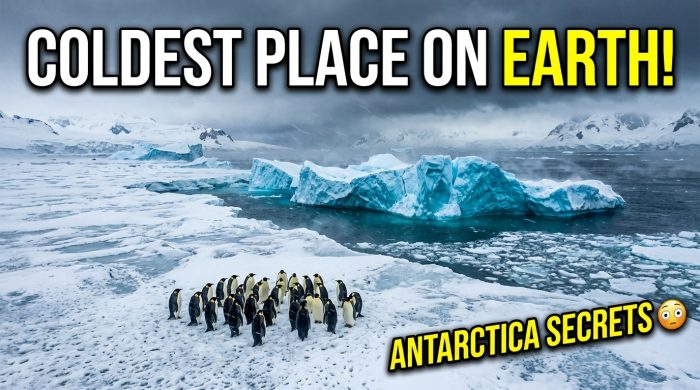
Introduction Antarctica is one of the most mysterious and fascinating places on Earth. Located at the southernmost point of the planet, this frozen continent is unlike any other. Covered almost entirely in ice, Antarctica holds the key to understanding global climate, sea-level rise, and Earth’s environmental future. Despite its harsh conditions, Antarctica attracts scientists, explorers, and researchers from around the world. In this detailed guide, we’ll explore its history, geography, climate, wildlife, and why it matters to the entire planet.
Map & Geographic Overview Antarctica surrounds the South Pole and is encircled by the Southern Ocean. It is the fifth-largest continent, covering approximately 14 million square kilometers. The continent is divided into two main regions:
East Antarctica: Larger, colder, and more stable
West Antarctica: Smaller but more vulnerable to melting
Major geographical features include:
Transantarctic Mountains – divides East and West Antarctica
Ross Ice Shelf – one of the largest floating ice shelves
Weddell Sea – known for dense sea ice Nearly 98% of Antarctica is covered in ice, with an average thickness of about 1.9 kilometers. This ice contains around 70% of the world’s fresh water.

The idea of a southern continent dates back to ancient times, when Greek philosophers imagined a land called “Terra Australis.”
The first confirmed sighting of Antarctica occurred in 1820 by a Russian expedition led by Fabian Gottlieb von Bellingshausen.
The early 20th century marked the “Heroic Age of Exploration,” when famous explorers raced to reach the South Pole:
In 1959, the Antarctic Treaty was signed, ensuring that Antarctica would be used only for peaceful scientific research. This treaty remains one of the most successful international agreements in history.

Antarctica is the coldest, driest, and windiest continent on Earth.
Antarctica experiences extreme seasonal changes:
Powerful katabatic winds, which flow downhill from the interior, can reach speeds over 200 km/h.
Although the interior is almost lifeless, Antarctica’s coastal regions are rich in biodiversity.
The Antarctic ecosystem depends heavily on krill, tiny shrimp-like creatures that form the base of the food chain.
Antarctica plays a critical role in global science and environmental studies.
Research stations from many countries operate year-round, making Antarctica a global hub for scientific collaboration.
Antarctica is at the center of global climate discussions.
Melting ice sheets in West Antarctica could significantly raise sea levels worldwide. Even small changes in temperature can have massive global impacts.
The continent also affects ocean currents and weather patterns, making it crucial for maintaining Earth’s balance.
The future of Antarctica depends on global cooperation and climate action.
With increasing interest in resources and tourism, protecting this fragile environment is more important than ever. The Antarctic Treaty continues to play a key role in preserving the continent.
Antarctica is more than just a frozen land—it is a vital part of Earth’s ecosystem. From its rich history of exploration to its importance in climate science, Antarctica remains one of the most important regions on the planet.
Understanding Antarctica helps us understand our world—and protect its future.
Section-11, Block-A, Road-4, House-14, (Sirajuddin Tower), Level-2-C, Mirpur, Dhaka-1216. Mobile : 01674-164949. Email: www.newseasonit.com
All rights reserved © 2026 fastinfoworld