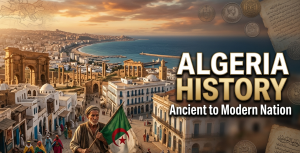
Algeria, the largest country in Africa, has a rich and complex history shaped by indigenous cultures, foreign invasions, colonial rule, and a hard-fought struggle for independence. Located along the Mediterranean coast, Algeria has served as a crossroads of civilizations for thousands of years. This report explores the major phases of Algeria’s history, from ancient times to its modern political landscape.
The earliest inhabitants of Algeria were Berber tribes, also known as Amazigh people. These indigenous communities developed unique cultures and languages long before the arrival of foreign powers.
By around the 12th century BCE, Phoenician traders from Phoenicia established coastal settlements, the most notable being Carthage. These settlements became part of a vast Mediterranean trading network.
During this time, the region was divided into various Berber kingdoms, including Numidia. One of the most famous rulers was Masinissa, who unified much of the territory and allied with Rome during the Punic Wars.

After the fall of Carthage in 146 BCE, Algeria came under Roman control. The Romans developed the region extensively:
Built cities such as Timgad and Djemila
Introduced advanced agriculture, especially wheat production
Expanded trade networks across the empire
Roman Algeria became one of the empire’s most prosperous regions. Christianity also spread during this period, producing influential figures such as Saint Augustine.
After the decline of the Roman Empire, the Byzantines briefly controlled the region, but their influence remained limited.
In the 7th century, Arab Muslim armies arrived in North Africa, bringing Islam and Arabic culture. The region gradually became part of the Islamic world.
Islam spread widely among the Berber population, though not without resistance. Over time:
Arabic became a dominant language
Islamic governance systems were established
Trade routes expanded across the Sahara
Several Islamic dynasties ruled Algeria, including the Almoravids and Almohads, who played key roles in shaping the region’s religious and political identity.

In the early 16th century, Algeria became part of the Ottoman Empire. The Ottomans established control through local rulers known as Deys.
Algiers became a powerful center of maritime activity, often associated with piracy in European accounts. The region maintained a degree of autonomy while still being part of the Ottoman system.
During this period:
Trade and naval power increased
Relations with European powers were often hostile
Local governance structures evolved
Ottoman rule lasted for over three centuries, until the arrival of the French.
In 1830, France invaded Algeria, beginning one of the most significant and transformative periods in its history. Algeria was not just a colony—it was considered an integral part of France.
French colonization had profound effects:
Large numbers of European settlers (colons or “pieds-noirs”) moved to Algeria
Indigenous Algerians were displaced from their lands
Economic systems were restructured to benefit France
Cultural and religious tensions intensified
Algerians faced discrimination and were denied basic rights. Resistance movements began early but were often suppressed.
The struggle for independence intensified in the mid-20th century. In 1954, the National Liberation Front launched a revolution against French rule.
The Algerian War was brutal and complex:
Guerrilla warfare and urban conflict
Widespread violence and civilian casualties
Use of torture and repression by French forces
The war attracted international attention and became a symbol of anti-colonial struggle.
One of the key leaders was Ahmed Ben Bella, who later became Algeria’s first president.
After years of conflict, the Evian Accords were signed, leading to Algeria’s independence in 1962.
After independence, Algeria faced the challenge of rebuilding a nation devastated by war. The FLN became the ruling party, establishing a socialist-oriented state.
Key developments included:
Nationalization of industries, especially oil and gas
Expansion of education and healthcare
Strong central government control
However, political freedoms were limited, and economic challenges persisted.
In the late 1980s, economic difficulties and public dissatisfaction led to political reforms. Multi-party elections were introduced.
In 1991, an Islamist party was poised to win elections, but the military intervened, canceling the process. This led to a violent conflict known as the Algerian Civil War.
The civil war lasted for about a decade:
Tens of thousands of people were killed
Widespread violence and instability
Deep social and political divisions
The conflict ended in the early 2000s, but its effects are still felt today.
In the 21st century, Algeria has worked toward stability and development. The country has significant natural resources, particularly oil and gas, which are central to its economy.
Recent developments include:
Efforts to diversify the economy
Youth-led protests demanding political reform (notably the Hirak movement)
Leadership changes, including the resignation of long-time president Abdelaziz Bouteflika in 2019
Algeria continues to balance economic challenges with demands for political reform.
Algeria’s history has left a rich cultural legacy:
A blend of Berber, Arab, and French influences
Diverse languages, including Arabic, Berber (Tamazight), and French
Strong traditions in music, literature, and art
Historical sites such as Roman ruins and Islamic architecture attract global interest.
The history of Algeria is a story of resilience, resistance, and transformation. From ancient Berber kingdoms to Roman provinces, from Ottoman rule to French colonization, and finally to independence and modern statehood, Algeria has undergone significant changes.
Its struggle for independence remains one of the most powerful examples of anti-colonial resistance in the 20th century. Today, Algeria stands as a nation shaped by its past, facing the challenges of the present, and looking toward the future.
Understanding Algeria’s history is essential to appreciating its identity, culture, and role in the global community.
Section-11, Block-A, Mirpur, Dhaka-1216. Mobile : 01700 000000. Email: fastinfoworldinfo@gmail.com
All rights reserved © 2026 fastinfoworld